
Achilles Tendinopathy Treatment in St. Albert
Achilles pain has a habit of sneaking up on runners. A little stiffness at first, then something you can’t train through.
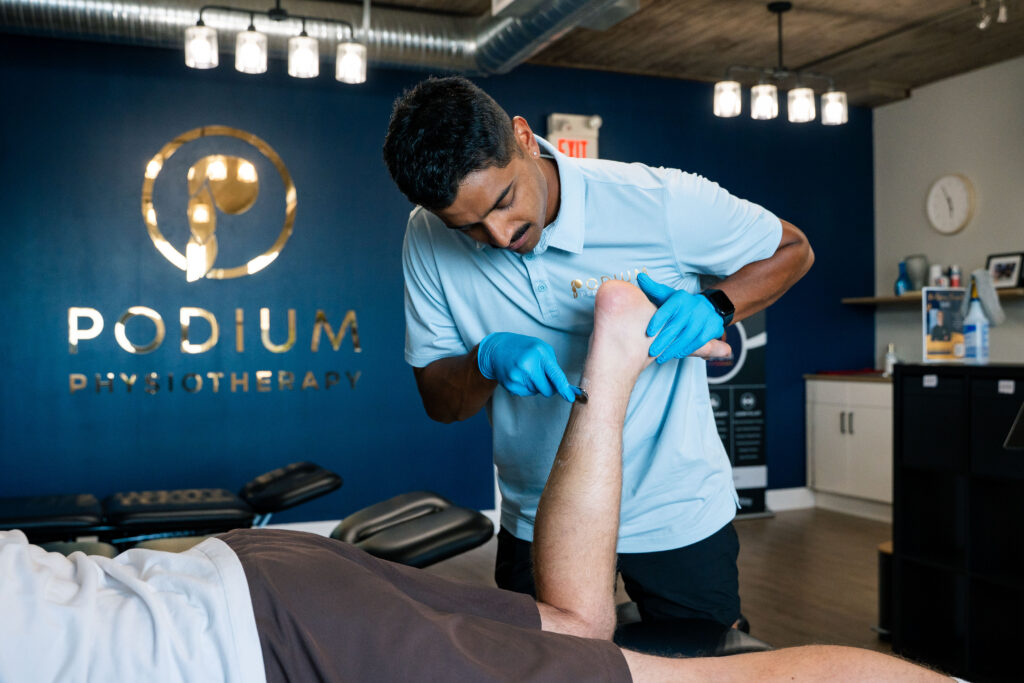
We treat Achilles tendinopathy in St. Albert with one-on-one physiotherapy, progressive tendon loading, calf strengthening, and a gait assessment to find out what’s actually driving the irritation. Whether this started last week or has dragged on for months, we’ll build your return-to-running plan around your training goals, not a generic protocol.
What is Achilles Tendinopathy?
Achilles tendinopathy is a condition involving irritation, sensitivity, and degeneration of the Achilles tendon, which connects the calf muscles to the heel bone. The Achilles tendon plays an important role in walking, running, jumping, climbing stairs, and pushing off the foot during athletic movement.
This condition commonly affects runners and active individuals, but it can also develop in anyone who places repeated stress on the tendon. Achilles tendinopathy often happens when the tendon is asked to handle more load than it is currently prepared for. This may happen after a sudden increase in running volume, hill training, jumping, sport, or a change in footwear.
At Podium Physiotherapy in St. Albert, we help identify the factors contributing to your Achilles pain and guide you through a structured treatment plan focused on reducing symptoms, improving tendon capacity, and helping you return to activity safely.
Common Symptoms of Achilles Tendinopathy
Achilles tendinopathy can cause pain, stiffness, and reduced performance during sport, exercise, or everyday movement. Symptoms may come on gradually and often feel worse first thing in the morning or at the beginning of activity.
Physiotherapy can help address:
- Pain at the back of the heel
- Pain or stiffness along the Achilles tendon
- Morning stiffness
- Pain during running or jumping
- Tenderness when squeezing the tendon
- Discomfort when walking uphill or climbing stairs
- Calf tightness or weakness
- Reduced ankle mobility
- Reduced athletic performance
- Pain that warms up during activity but returns afterward
The goal of Achilles tendinopathy treatment is not just to reduce pain. It is to rebuild the tendon’s ability to tolerate load so you can move, train, and perform with more confidence.
Why Does Achilles Tendinopathy Happen?
Achilles tendinopathy often develops when the tendon is overloaded or does not have enough time to recover between activities. This can happen after changes in training, footwear, terrain, strength, mobility, or overall recovery. Common contributing factors include:
Sudden increases in training volume
Running hills
Increased speed work or jumping
Poor footwear or a recent footwear change
Poor recovery between workouts
Calf weakness
Limited ankle mobility
Reduced foot or hip control
How Physiotherapy Helps
At Podium Physiotherapy, Achilles tendinopathy treatment focuses on:
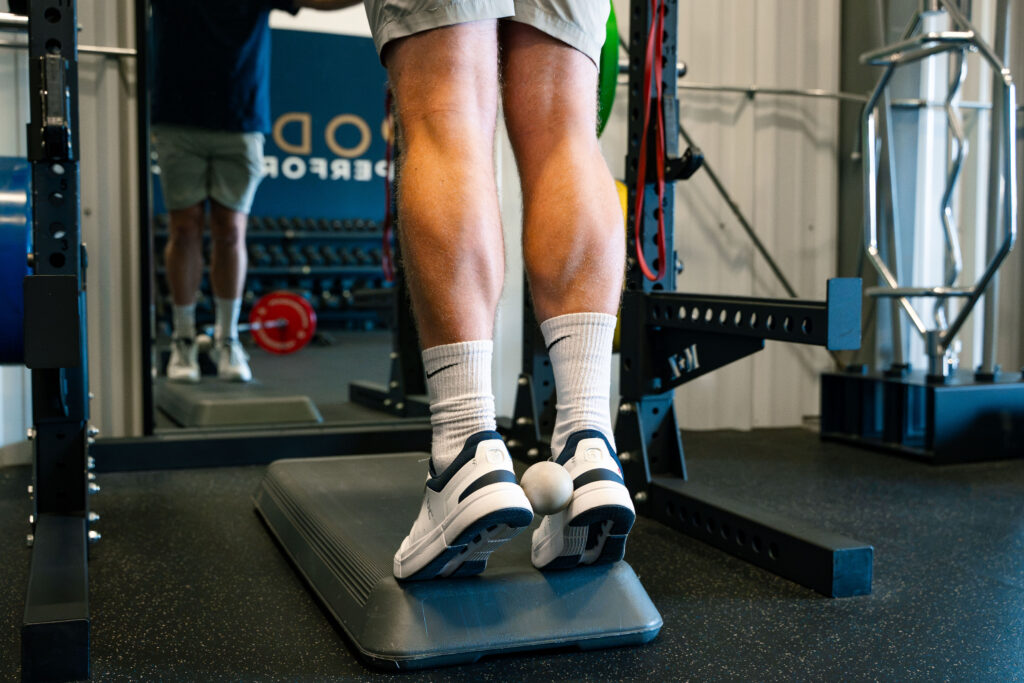
- Progressive tendon loading programs
- Calf strengthening
- Foot, ankle, and hip strengthening
- Running gait assessment
- Mobility exercises
- Return-to-running plans
- Activity modification
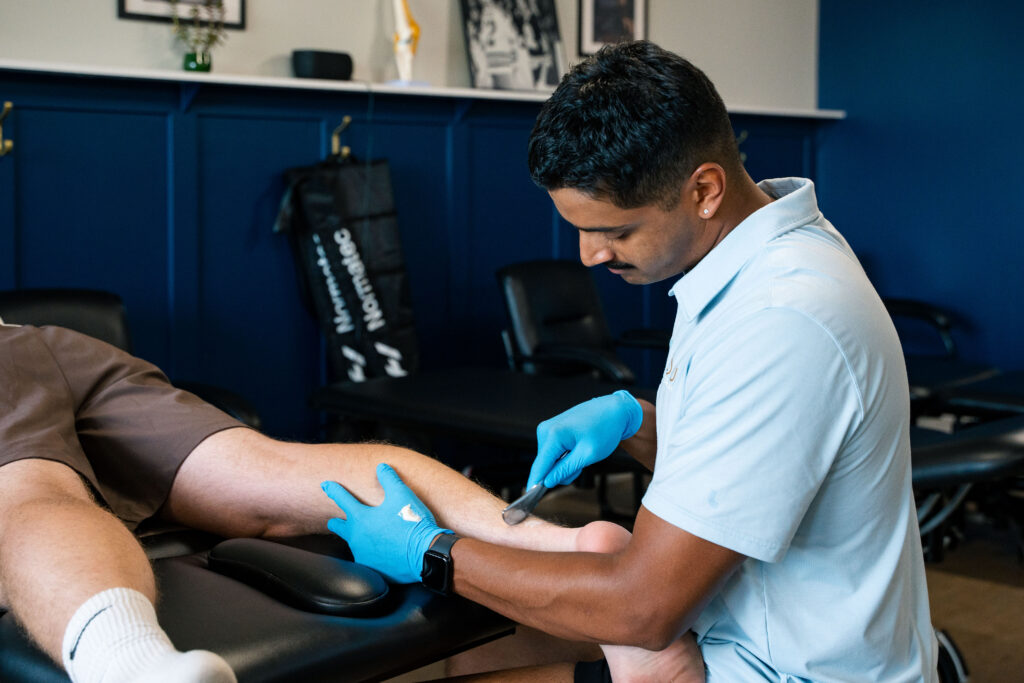
- Dry needling, when appropriate
- Education on training load and recovery
- Strategies to reduce recurrence
Physiotherapy helps guide your recovery by matching the right exercises to your current symptoms and tendon capacity. In the early stages, treatment may focus on calming symptoms, adjusting activity, and introducing safe loading exercises. As symptoms improve, your program becomes more strength-focused, helping the Achilles tendon and calf muscles tolerate more demand.
For runners and athletes, treatment may also include a gait assessment, return-to-running progression, plyometric exercises, and sport-specific loading. This helps bridge the gap between feeling better and being ready to train or compete again.
Recovery Timeline
Recovery from Achilles tendinopathy depends on how long symptoms have been present, how irritated the tendon is, and how consistently the tendon is loaded through rehab. Your physiotherapist will adjust your plan based on your symptoms, strength, mobility, and activity goals.
Mild Cases: 2–6 Weeks
- Reduce tendon irritation
- Modify painful activities
- Begin progressive calf loading
Moderate Cases: 2–6 Months
- Build calf and tendon strength
- Improve ankle mobility and control
- Gradually return to running or sport
Chronic Cases: 6+ Months
- Address long-term tendon sensitivity
- Progress heavier strengthening
- Rebuild tolerance for higher-impact activity
Return to Training
- Follow a structured return-to-running plan
- Reintroduce hills, speed, and jumping gradually
- Continue strength work to reduce recurrence
Why Choose Podium Physiotherapy?
At Podium Physiotherapy, your full appointment is spent working directly with a physiotherapist. We take the time to understand your symptoms, training history, footwear, activity goals, and the movements that aggravate your Achilles pain. Your plan is not one-size-fits-all. It is built around your tendon capacity, your sport, and your recovery progress.
Our St. Albert clinic combines hands-on physiotherapy, rehab science, progressive strength training, gait assessment, and education to help you recover safely and reduce the risk of Achilles pain returning. We create individualized rehabilitation plans based on current tendon research and help athletes return to training with confidence.
Adrienne Carlton
★★★★★
I completely ruptured my Achilles tendon, and when it came time to get out of my cast, the specialist at the hospital I’ve been seeing recommended me to Podium. I’m so glad that I made this a priority. After each visit, I noticed a tangible change in my strength and ability to move. It’s a long road of recovery and having my mobility for my job as a realtor and as a dancer is extremely important to me. So, the sooner I get back to normal, the better and this has been so worth the investment! You can’t put a price on having your physical freedom! Thank you, Podium, for taking good care of me!
Shantel Lea
★★★★★
I am recovering from a ruptured Achilles which is as much mental as physical. I tried another physio and had sub par treatment and results. Brendan and Podium have been a game changer for me. I feel positive for the first time about my recovery. The exercises are tailored to accommodate my RA as well. I feel stronger each week and look forward to returning to an active lifestyle!
Book Achilles Tendinopathy Treatment in St. Albert
Achilles tendinopathy can be frustrating, especially when it keeps you from running, training, walking comfortably, or participating in the activities you enjoy. The right physiotherapy plan can help you manage pain, rebuild strength, and improve your tendon’s ability to handle load over time.
At Podium Physiotherapy, we help active individuals in St. Albert recover from Achilles tendon pain with a personalized plan designed around their symptoms, goals, and lifestyle.
Book your Achilles tendinopathy treatment appointment online today.
Achilles Tendinopathy FAQs
Morning stiffness is one of the most common symptoms of Achilles tendinopathy. This can happen because the tendon is less mobile after a period of rest and becomes sensitive when it is loaded again first thing in the morning.
Not necessarily. Many runners can continue modified training while completing an appropriate rehabilitation program. Your physiotherapist can help you decide what level of running is safe and when you should reduce or temporarily stop certain activities.
Some mild cases improve with reduced activity and better recovery, but most people recover faster and more completely with a structured strengthening program. Physiotherapy helps address the reason the tendon became irritated in the first place.
Progressive calf and ankle strengthening exercises are often the foundation of treatment. Depending on your stage of recovery, your plan may include isometric holds, calf raises, heavy slow resistance training, balance work, mobility exercises, and return-to-running drills.
Stretching alone is rarely enough to fix Achilles tendinopathy. Most cases require a progressive loading program to improve tendon capacity, along with activity modification and strength work.
Recovery may range from several weeks to several months depending on the severity and duration of symptoms. Chronic Achilles tendinopathy often takes longer and usually requires a consistent strengthening and loading plan.
In many cases, yes. Activity modifications may be needed while symptoms improve. Your physiotherapist can help you choose exercises that maintain fitness without overloading the tendon.
Training errors, rapid increases in activity, calf weakness, limited ankle mobility, poor recovery, footwear changes, hill running, and repeated jumping or sprinting can all contribute to Achilles tendinopathy.
Posted on Google
 CG
CGTrustindex verifies that the original source of the review is Google.
I can’t recommend Fathi enough! Coming back to the gym after having my baby was intimidating, but he made me feel comfortable and supported from the very beginning. He’s been incredibly patient, knowledgeable, and always finds creative ways to adapt workouts to what my body needs. Along the way, he even diagnosed an issue I’ve had for most of my adult life! It has been almost life changing re-discovering my strength and self and I owe that all to Fathi. If you’re looking for a personal trainer who genuinely cares and knows how to help you achieve your goals, I highly recommend Fathi!Posted on Google C HoltI’ve been coming to Podium for the last five months and have been honestly very impressed. Fathi is a fantastic trainer who is knowledgeable, encouraging, and genuinely invested in helping me reach my goals. Nathan is a knowledgeable and compassionate physiotherapist, and I really appreciate how they work together to support both training and recovery. I highly recommend Podium if you’re looking for a great place to train and take care of your overall health and wellness.Posted on Google
 Grace CrockerI came to Podium for help with hip issues from a running injury. Brendan has been amazing with healing and strengthening my hip to get me back into running. Over 4 months now and have started seeing results and have slowly gotten back into running. Definitely recommend to anyone looking for a physio!Posted on Google
 Ken KBrendan rehabed my surgically repaired bicep 3 years ago and is not in the process of rehabing my surgically repaired pectoral tendon. He is a great physiotherapist.Posted on Google
 Hannah ANathan was fantastic at Podium Physiotherapy! He addressed all my concerns and gave me effective solutions. I love that the clinic has a full gym and they lead you through many rehab exercises.Posted on Google
 Nate BenoitI had an excellent experience with Nathan M and Zach W! They both helped me find much needed relief from long term back pain through hands-on work and through targeted exercises to eliminate the issues all together! Highly recommend!Posted on Google
 Ross OudkerkNathan is an amazing physio, knowledgeable and great to converse with to determine the best form of care/diagnosis. Excellent facility, & equipment too. Highly recommend!Posted on Google
 Emma Mwent for a wrist injury and had Nathan helping me and he’s great. very nice and very clear about the treatment and exercises needed, also gets back to me really quick when I email with questions. all of the staff are very friendly and helpful.Posted on Google
 Shantel LeaI am recovering from a ruptured Achilles which is as much mental as physical. I tried another physio and had sub par treatment and results. Brendan and Podium have been a game changer for me. I feel positive for the first time about my recovery. The exercises are tailored to accommodate my RA as well. I feel stronger each week and look forward to returning to an active lifestyle!